The $840,000 Nobody Modeled

What Your Workforce Knows That the Acquisition Model Doesn’t. And What That Gap Costs You at the Closing Table
The acquisition inquiry arrived on a Tuesday. Four sentences. A fund principal. An EBITDA multiple. A 30-day window.
What the email did not mention is that the fund’s automation readiness model has already assigned a projection to your workforce. It projects a 33–42% labor cost reduction within 12 to 18 months of system go-live. That projection was built from industry benchmarks. It was not built from a conversation with anyone on your floor.
It was not built from the pick route your most senior associate has optimized over nine years. The shortcut through seasonal staging that shaves four to six minutes off the east-side loop on every cycle and exists in no process document. It was not built from the line lead who has spent twelve years learning which failure modes the official process doesn’t account for and routing around them before management gets a call. It was not built from the Monday throughput pattern in aisle 14 that your team has been compensating for since year two.
The fund’s model does not know any of that exists. What it cannot see, it discounts. And the gap between what the model assumes about your workforce and what your workforce actually knows is sitting in the acquisition conversation as an unmodeled cost, one that will appear somewhere between the LOI and the closing table, in a form that comes out of your proceeds.
That gap is the subject of this article. It has a name, a documented dollar range, and a median. The median is $840,000. It was not in any vendor proposal across twelve documented deployments. It was not in any acquisition model on either side of any of those transactions. It showed up. Every time. After the fact, in the form of data archaeology.
The seller who documents it first is having a different conversation than the seller who doesn’t.
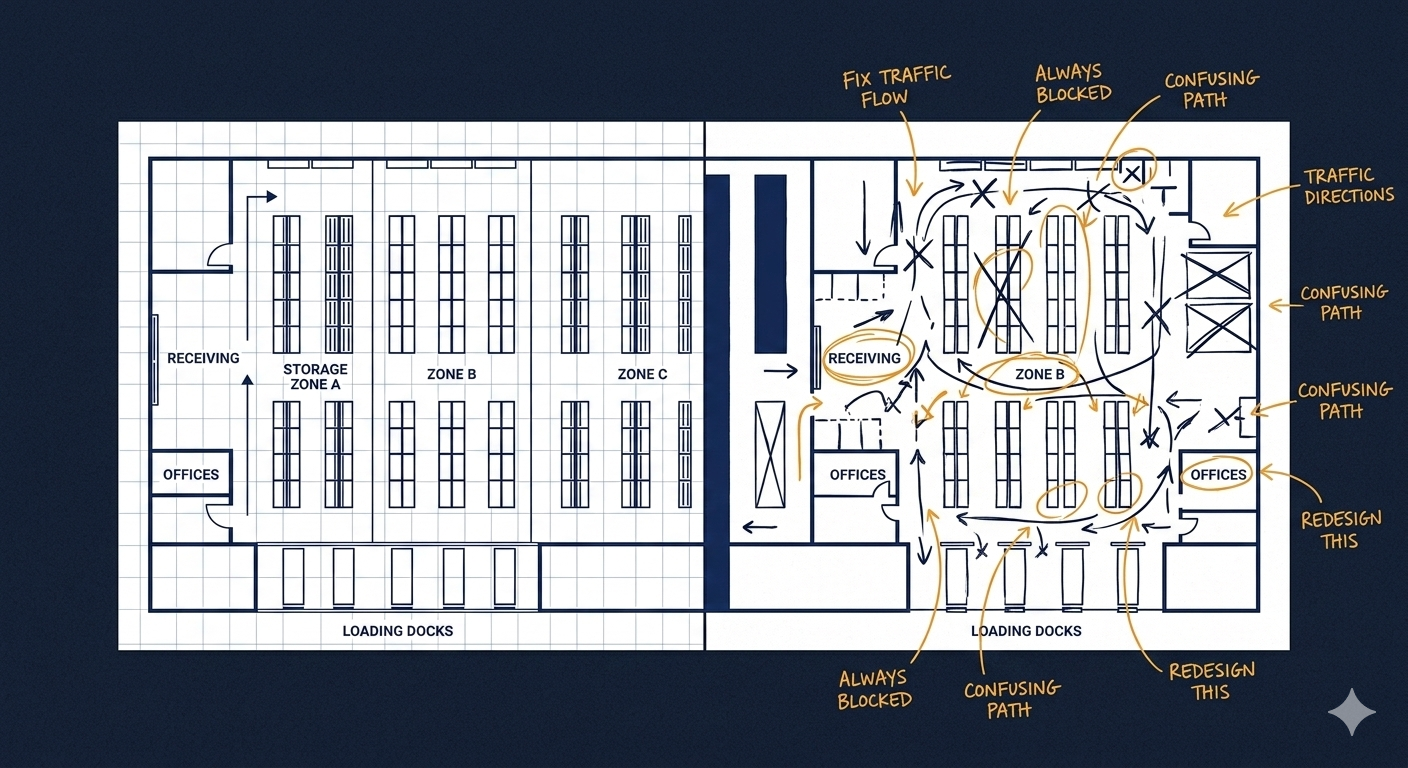
What the Acquisition Model Assumes About Your Workforce
PE firms acquiring distribution and industrial assets in 2025 are doing so with automation deployment assumptions embedded in their post-acquisition EBITDA projections. Those projections assume a labor cost reduction (typically 33–42%) achievable within 12 to 18 months of system go-live. They are built from the same vendor benchmarks that appear in every automation proposal: steady-state performance figures, calibrated to past wins, using site survey data that measured the aisles, photographed the WMS interface, and recorded throughput statistics from the system log.
What those benchmarks do not include is the operational knowledge your workforce carries that is not in any system. The site survey measures what the building looks like. The people running the building know how it actually works. Those are different things, and only one of them was in the proposal.
The gap between the benchmark and the operational reality is the ramp. Every automation deployment has one. The empirical median for first-24-month labor savings across twelve documented deployments is 21–28%, against a vendor projection of 33–42%. Memphis delivered 22%. The difference between the projected savings and the actual savings during ramp is not a failure of the technology. It is the cost of deploying a system that was configured without the knowledge your floor has been accumulating for years.
A PE buyer’s automation readiness audit uses the same benchmarks the vendor used. What it cannot see, it cannot credit. Your workforce’s operational depth is an asset that the acquisition model is structurally unable to value, unless you document it first.

What Your Workforce Knows That the Model Doesn’t
The operational knowledge a tenured workforce carries exists in three dimensions. Each one is measurable. None of them appear in a standard site survey or vendor proposal.
-
What breaks, in what sequence, under what conditions, and what the team does about it before management knows it happened. This knowledge is not anecdotal, it is the accumulated output of years of real operating conditions. A line lead with twelve years in a building has triaged every failure mode the official process doesn’t account for. When the new system surfaces a configuration gap, he routes around it before the dashboard registers a problem. His knowledge is the reason the building stayed functional during a 14-month ramp while the official metrics reported normal operations. That knowledge was not captured during the vendor’s site survey. It is not in the system. If it is not documented before the acquisition conversation begins, the buyer’s model treats it as zero.
-
The workarounds that accumulated over years because the official process doesn’t account for real operating conditions. The shortcut through seasonal staging. The Monday replenishment adjustment. The Tuesday vendor sequencing pattern. None of these are in any process document because they were never officially sanctioned, they were developed by people who run the building every day and optimized for the reality the official process ignores. Together they represent years of implicit process engineering that keeps throughput above what the documented process would produce if followed exactly. The vendor’s system was configured without any of it. A buyer’s automation readiness audit cannot see it. What it cannot see, it discounts.
-
The specific, recurring reasons why throughput drops at specific times in specific zones. These do not appear in the system log because the system log records outcomes, not causes. A senior associate who has run the same route for nine years knows that aisle 14 runs 18% below average on Mondays because the weekend replenishment run is never fully completed before the first wave starts, and has been routing around it since year two. That pattern is invisible to the site survey. It is invisible to the buyer’s model. Documented, it is evidence of operational intelligence depth. Undocumented, it is a ramp risk the buyer prices into the offer.
“The $840,000 is not in the acquisition model on either side of the table. That is a negotiating fact. The seller who documents it first is having a different conversation.”

The $840,000 Category That No Model Includes
The HR Director at the Memphis facility spent three weeks pulling payroll records, severance documentation, retraining invoices, manager time allocation logs, and productivity variance data from the WMS log. She produced a number: $1.224 million. No model: vendor proposal, operator capital model, or acquisition model, had ever included this category. The implicit assumption in every document produced during the evaluation and approval process was that the cost was zero.
The category has four components. Each is measurable. Each is absent from the standard vendor proposal and the standard acquisition model.
-
Eleven roles were eliminated in the first 18 months of the Memphis deployment. The direct cost: severance payments, recruiting and onboarding for backfill roles, and the productivity gap during the backfill period, was calculable from payroll records. It had never been in any budget line because no one had been asked to put it there. A buyer who finds it in due diligence uses it to justify a price adjustment. A seller who documents it first uses it to frame the acquisition conversation on his own terms.
-
The vendor provided system training. It did not provide the operational knowledge the system assumes the workforce already has: the ability to recognize system anomalies, triage faults in real time, and maintain throughput during partial system degradation. That knowledge is developed on the floor, during ramp, at the throughput cost of the learning curve. The gap between what the building produced during ramp and what it would have produced with a prepared workforce is real, calculable from the WMS log, and absent from every transition model. A seller who has quantified this gap, and documented the steps taken to close it, is presenting a different asset than one who hasn’t.
-
The throughput gap between what the old system produced and what the new system produced during ramp lasted 14 months at Memphis. The cost per month was calculable from the same WMS log the vendor used to establish the baseline throughput projection. The projected savings and the transition-period loss were never in the same model. In an acquisition context, that gap (documented by the seller before due diligence) converts from a liability to a data point the seller controls.
-
The line lead with twelve years of building knowledge became the de facto implementation support resource during the Memphis ramp: absorbing failure modes, routing around configuration gaps, translating between what the system showed and what was actually happening on the floor. That labor is not free. When informal knowledge becomes the primary mechanism keeping a ramp operational, the reallocation of that management capacity is a real cost. It is also an asset, evidence that the building has the kind of operational depth that survives a 14-month transition without a formal support structure. Documented, that is a premium. Undocumented, it is invisible.
Across twelve deployments, workforce transition costs ranged from $380,000 to $2.1 million. The median was $840,000. Every operator absorbed that cost. Every vendor proposal treated the category as nonexistent. Every acquisition model on both sides of every transaction treated it the same way. The seller who produces that number before the buyer does is not eliminating the cost. He is controlling the conversation about it.

What to Do Before the Acquisition Conversation
Four actions. All of them completable before the next call with a fund principal. None requiring a significant budget. All of them requiring the decision to treat your workforce’s operational knowledge as an asset to be documented, not a transition problem to be managed.
Schedule the knowledge capture session before the buyer’s team arrives.
Two hours. The three highest-tenure associates in each major pick zone. A structured facilitator with a documented output template. The questions: What breaks, and when? What workarounds does the team use that are not in any process document? Where does throughput drop and why? What does the proposed system configuration not account for that you know from experience? The output is documentation of your operational intelligence depth — the same depth the buyer’s automation readiness audit cannot see and therefore discounts. A buyer who receives this documentation is looking at a different asset than one who does not. The cost is four hours of implementation labor. The alternative is having the buyer’s team arrive first and treat everything they cannot see as a ramp risk.
Build the workforce transition cost model before the LOI.
The four components — displacement, retraining, productivity loss during transition, manager time — are estimable from existing HR and WMS data before any buyer conversation begins. The $840,000 documented by the seller is a negotiating position. The $840,000 discovered by the buyer is a price reduction. Those are different outcomes for the same number. The operator who builds this model before the LOI arrives has a documented cost basis, an accountability structure, and a number that cannot be used against him in the way it was used at Memphis.
Document the informal knowledge as an operational asset.
The east-side route shortcut, the Monday aisle 14 pattern, the line lead’s twelve years of failure mode knowledge — each of these has measurable throughput value. Documented, they are evidence of operational depth that a system cannot replicate in month one and that survives the ramp period because it exists in people, not in configuration files. An acquisition narrative that includes this documentation is presenting a more defensible automation readiness story than one that does not. The buyer’s model will discount what it cannot see. Give it something to see.
Understand what the buyer’s automation projection assumes about your workforce.
A fund projecting 33–42% labor cost reduction within 12 months is projecting steady-state performance, not first-24-month ramp performance. The empirical range for first-24-month savings is 21–28%. Memphis delivered 22%. The seller who understands the difference between those two numbers — and can articulate why his workforce’s operational depth narrows that gap — is negotiating on the basis of evidence. The seller who accepts the projection without interrogating it is negotiating on the basis of the buyer’s model.
What NexusGate Does With This
The framework in this article, the knowledge capture session, the workforce transition cost model, the operational asset documentation, is the preparation side of the acquisition conversation. It tells you what to build before the LOI arrives. That analysis is free and always will be.
The introduction side is different. For business owners who have done the preparation and want to understand which specific capital partners (PE funds, family offices, search funds) are the right fit for their business before the formal process begins, NexusGate provides that introduction.
NexusGate operates as a business introduction service, connecting qualified industrial and distribution business owners with PE investors, family offices, and search funds on a flat-fee finder model. No commission. No retainer. No broker relationship. The fee structure is designed for owners who want to understand the capital landscape without handing the process to an intermediary who earns more when the transaction is larger.
The owner who arrives at that conversation with a documented workforce transition cost model and a knowledge capture session output is presenting a different business than the owner who hasn’t run either. NexusGate’s introduction process is built for the former.
If you have received an acquisition inquiry and want to understand which capital partners fit your business before the next call, that conversation starts at NexusGate.io.
